Exploring Dubai Creek and Deira
Book an experience
Book this activity
These are the top-rated activities for this area — book ahead to lock in your preferred date.
The Dubai Creek area is the oldest part of the city and one of the few places where you can see what Dubai looked like before oil and construction capital arrived. The Creek itself — a natural saltwater inlet running inland from the Arabian Gulf — was the original reason for Dubai’s existence as a trading port. For most of the 20th century, dhows loaded with goods crossed between Deira and Bur Dubai, and traded with India, Iran, and East Africa. That trade continues today at reduced scale, and the heritage landscape around it has been well preserved.
The circuit covering Al Fahidi, the abra crossing, the Gold Souk, and the Spice Souk is one of the most compact and rewarding half-days in the country.
Al Fahidi Historical Neighbourhood
The starting point for most visits. Al Fahidi (sometimes called Bastakiya) is a restored district of 19th-century courtyard houses and wind towers — the tall square towers that channelled sea breezes into the rooms below in the days before air conditioning.
The neighbourhood is free to enter and free to walk around. Several small museums are scattered through the lanes:
Dubai Museum (Al Fahidi Fort): The emirate’s main history museum, in a fort that dates to 1787. Entry approximately AED 3 for adults, AED 1 for children under 6. Open Saturday–Thursday 8:30–20:30, Friday 14:30–20:30. Well presented exhibits cover pre-oil Dubai, pearl diving, and the Creek’s trading history. Allow 45 minutes.
Sheikh Mohammed Centre for Cultural Understanding: Runs guided cultural tours of the neighbourhood and Al Fahidi Mosque (one of the few mosques in Dubai open to non-Muslim visitors) as well as traditional Emirati breakfasts and dinners. Cultural tours run Saturday–Thursday at 10:00 for approximately AED 35. Book in advance.
XVA Gallery and Hotel: A boutique art gallery and café occupying a renovated wind-tower house. Good stop for coffee and a browse through contemporary regional art. Entry free.
The Abra Crossing
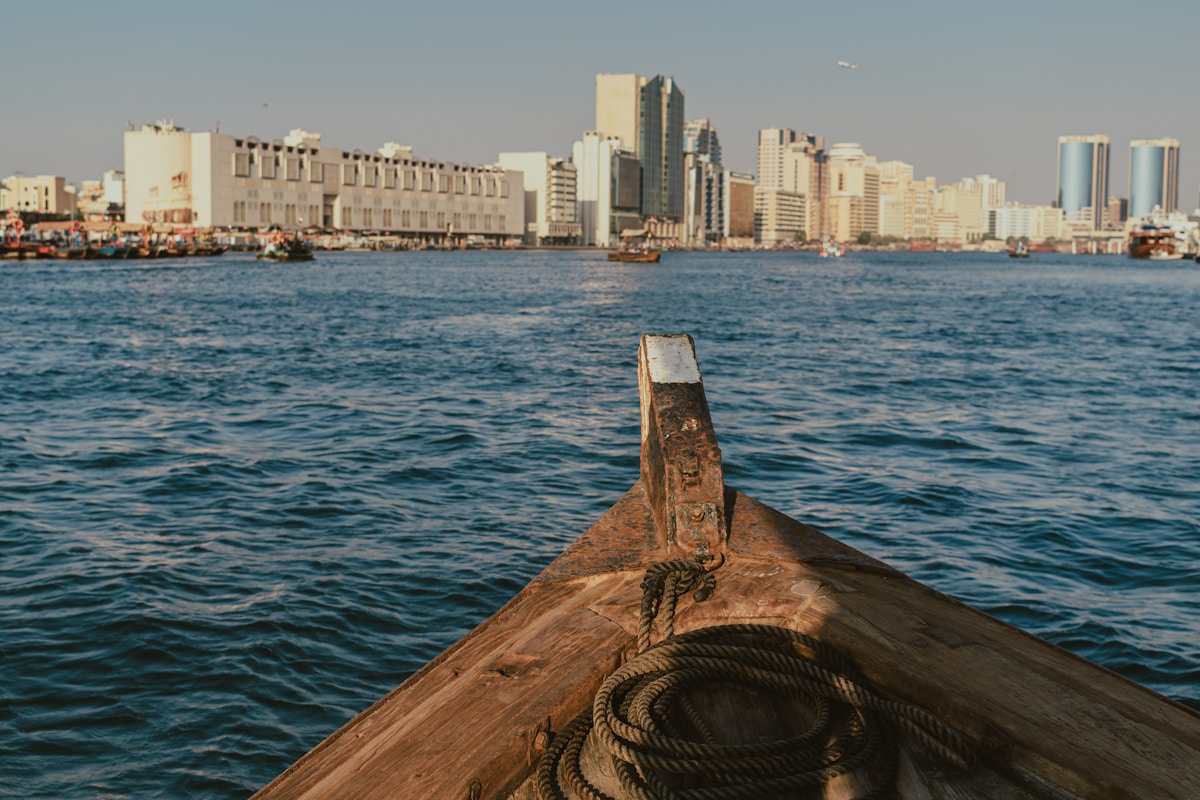
The abra — a small, flat-bottomed wooden motorboat — is the classic way to cross from Bur Dubai to Deira. The crossing takes around five minutes and costs approximately AED 1 per person (pay the driver directly). Abras run continuously from early morning until late at night on the shared water taxi route.
There are also abra tours along the Creek for approximately AED 100–150 per hour if you want a longer, more leisurely view of the waterfront and the dhow yards. Charter an abra from the landing steps at either waterfront — negotiate the price before boarding.
Deira Gold Souk
Over 300 jewellery shops cover perhaps the densest concentration of gold jewellery on sale anywhere in the world. Shop windows display large quantities of 18ct and 22ct gold necklaces, bangles, and rings. The weight of gold on display — rather than individual craftsmanship — defines the aesthetic.
Prices are set by the daily gold rate, which is posted in many shops and is broadly consistent across the souk. The craft premium on standard pieces is low, making this genuinely good value compared to European jewellery retail. Haggling on making charges (the labour component, not the gold weight) is standard and expected. Allow 30–60 minutes to browse.
Deira Spice Souk
A five-minute walk from the Gold Souk, the Spice Souk is a covered warren of stalls selling dried spices, rose water, frankincense, oud (agarwood) resin, and saffron in open sacks. The frankincense and oud trade connects this market to the same Indian Ocean commerce that built Dubai in the first place.
Prices are negotiable on most items. Saffron in particular is significantly cheaper here than in European supermarkets. A 1-gram portion of Iranian saffron — enough for several dishes — costs approximately AED 15–25 depending on grade and your negotiating.
The Dhow Wharves
Behind the Deira corniche, large wooden dhows — traditional sailing vessels now typically powered by diesel engines — are moored at the waterfront, often being loaded or unloaded by hand. The cargo is visible on deck: washing machines, fridges, electronics, car parts destined for ports along the Indian Ocean coast.
The scene on the Deira waterfront around dawn and early morning is one of the most visually striking in Dubai. No entry required — walk along the public waterfront road. Photography is fine but ask crew members before pointing a camera at them directly.
Where to Eat in Deira
Ravi Restaurant (Satwa, adjacent to the Creek area): One of Dubai’s most famous budget restaurants, run by Pakistanis since 1978. A full meal of curry, rice, and bread costs approximately AED 20–30. Often cited as the best value meal in the city.
Al Ustad Special Kabab: A long-established Iranian restaurant near the Gold Souk, serving grilled meats, saffron rice, and Persian stews. Approximately AED 40–60 per person. A reliable mid-range option in the souk area.
Cafeteria culture: The Deira side of the Creek is full of small Indian and Pakistani cafeterias serving chai (AED 3–4), fresh juice (AED 8–12), and simple meals. Eat where the workers eat — prices are low and food is typically fresh.
Practical Notes
Best time of day: Morning (8:00–11:00) for the dhow wharves and Dubai Museum before the crowds build. Evening (18:00 onwards) for the Gold Souk and Spice Souk when the temperature drops and both markets are at their busiest and most atmospheric.
Getting there by Metro: Union station on the Green Line is the most convenient for the Deira souk areas. Al Fahidi station on the Green Line is the closest to Al Fahidi Heritage District on the Bur Dubai side.
How long to allow: A focused visit to Al Fahidi, one abra crossing, and a souk browse takes about three hours. A full half-day allows for a museum, lunch, the dhow wharves, and a more leisurely walk through both souk areas.
GetYourGuide lists guided Old Dubai tours covering the Creek, Al Fahidi, the Gold Souk, and Spice Souk in a half-day.
See Also
- Dubai Dhow Cruise guide — the natural extension of a Creek visit
- Dubai Frame visitor guide — 10 minutes away by taxi, showing old and new Dubai simultaneously
- Things to do in Dubai
- Dubai travel guide
- Getting around Dubai
- 3-day Dubai itinerary
- UAE budget travel guide
Frequently Asked Questions
- How do you cross Dubai Creek?
- The traditional crossing is by abra — a small wooden motorboat that shuttles passengers between the Bur Dubai and Deira waterfronts for approximately AED 1–2 per person. Crossings run continuously from around 6:00 until midnight. There are also road bridges (Al Maktoum Bridge and Al Garhoud Bridge) and the Dubai Metro crosses at Union station.
- What are the opening hours of the Gold Souk in Deira?
- Most Gold Souk shops open approximately 10:00–22:00 Saturday–Thursday, with a midday break from around 13:00–16:00 in some shops. Friday hours are typically 16:00–22:00. The souk is busiest in the evening, particularly after 18:00 when the temperature drops.
- Is it safe to walk around Deira at night?
- Yes — Deira is a densely populated, busy commercial area with high foot traffic well into the evening. The main souk areas and the Creek waterfront are active until late. Standard city awareness applies but it is not an area that requires any particular caution.
Ready to explore?
Browse hundreds of tours and activities. Book securely with free cancellation on most options.
Browse on GetYourGuide →Best price guaranteed — same price as booking direct. We earn a small commission at no extra cost to you.