Dubai Food Tours: Eat Your Way Through Old Dubai and Deira
Book an experience
Book this activity
These are the top-rated activities for this area — book ahead to lock in your preferred date.
Contents
- Why a Guided Food Tour Makes Sense in Dubai
- The Best Dubai Food Tour Operators
- The Old Dubai Food Walk: Neighbourhood by Neighbourhood
- Al Fahidi Historical District
- Deira Spice Souk
- Shawarma Stands in Naif and Deira
- Meena Bazaar: Indian-Emirati Fusion
- Key Dishes to Know Before You Go
- Self-Guided Food Walk: The Essentials
- Practical Notes
- See Also
Dubai’s food scene is one of its most underappreciated assets. The city has a reputation for gleaming towers and luxury malls, but the most interesting eating happens in the narrow lanes of Old Dubai — in the Deira Spice Souk, the cafeterias lining Al Fahidi Street, and the streetside shawarma stalls that have fed the city’s workers since long before the Marina waterfront existed. A guided food tour is the fastest way to understand how the city actually eats.
Why a Guided Food Tour Makes Sense in Dubai
Dubai is disorienting for independent food exploration. The city sprawls across 35 kilometres, and the best traditional eating is concentrated in Old Dubai — an area that looks simple on a map but is easy to navigate badly without local knowledge. A good guide knows which shawarma stand opened in 1972 and still uses the same rotating spit, which cafeteria serves the city’s best karak tea, and why the Deira spice merchants stock seven varieties of cardamom when the supermarket stocks one.
Beyond geography, food tours provide cultural context that menus can’t. You’ll understand why Arabic coffee is served in a small, handleless cup and why shaking it means you’ve had enough. You’ll hear why Emirati cuisine was built around preservation — harees slow-cooked overnight, dried fish, date syrups — and how Indian Ocean trade routes deposited saffron, cardamom, and dried limes into a cuisine that feels simultaneously Arab and South Asian.
The Best Dubai Food Tour Operators
Frying Pan Adventures is the most well-regarded food tour operator in the city. Founded in Dubai and run by people who have spent years documenting the UAE’s food culture, their Old Dubai walking tours cover Al Fahidi, the Creek, and Deira over approximately 3.5 hours with around 10–15 tastings. Group tours cost approximately AED 395–420 per person (as of 2026). Private tours are available from approximately AED 750 per person. Their tours cap at around 10 people. Book directly on their website or through GetYourGuide.
Arabian Food Tour operators on GetYourGuide offer similar Old Dubai routes at slightly lower price points — from approximately AED 350 per person for a group tour. Quality varies by guide; read recent reviews before booking. The advantage is often more flexible scheduling, including morning and evening departures.
Context Travel runs smaller, more academic food tours (typically a maximum of 6 people) led by local food writers and culinary historians. Their tours lean more towards food culture and history than volume of tastings. Priced at approximately AED 550–650 per person. Better suited to travellers with a genuine interest in food history than to those prioritising quantity.
For self-booked tours, GetYourGuide lists all currently available Dubai food walking tours with verified reviews and transparent cancellation policies.
The Old Dubai Food Walk: Neighbourhood by Neighbourhood
Al Fahidi Historical District
Most tours begin here, in Dubai’s oldest surviving neighbourhood. The restored wind-tower houses of Bastakiya now contain cafés and small museums, but the lanes around it still have the feel of the trading town that preceded the oil economy. The standard opening stop is karak tea — a strong, spiced black tea brewed with condensed milk and cardamom, served in small plastic cups for approximately AED 3–5. Karak is the daily fuel of Dubai’s South Asian working population and has been adopted by virtually everyone in the city. There is a strong argument it is the defining drink of modern Dubai.
Nearby stalls sell samboosa — fried or baked pastry triangles filled with spiced lamb or vegetables, similar to Indian samosas and arriving via the same Indian Ocean trade routes that shaped so much of this cuisine. Approximately AED 5–10 for a portion. Usually freshest in the late morning when the first batch comes out.
Deira Spice Souk
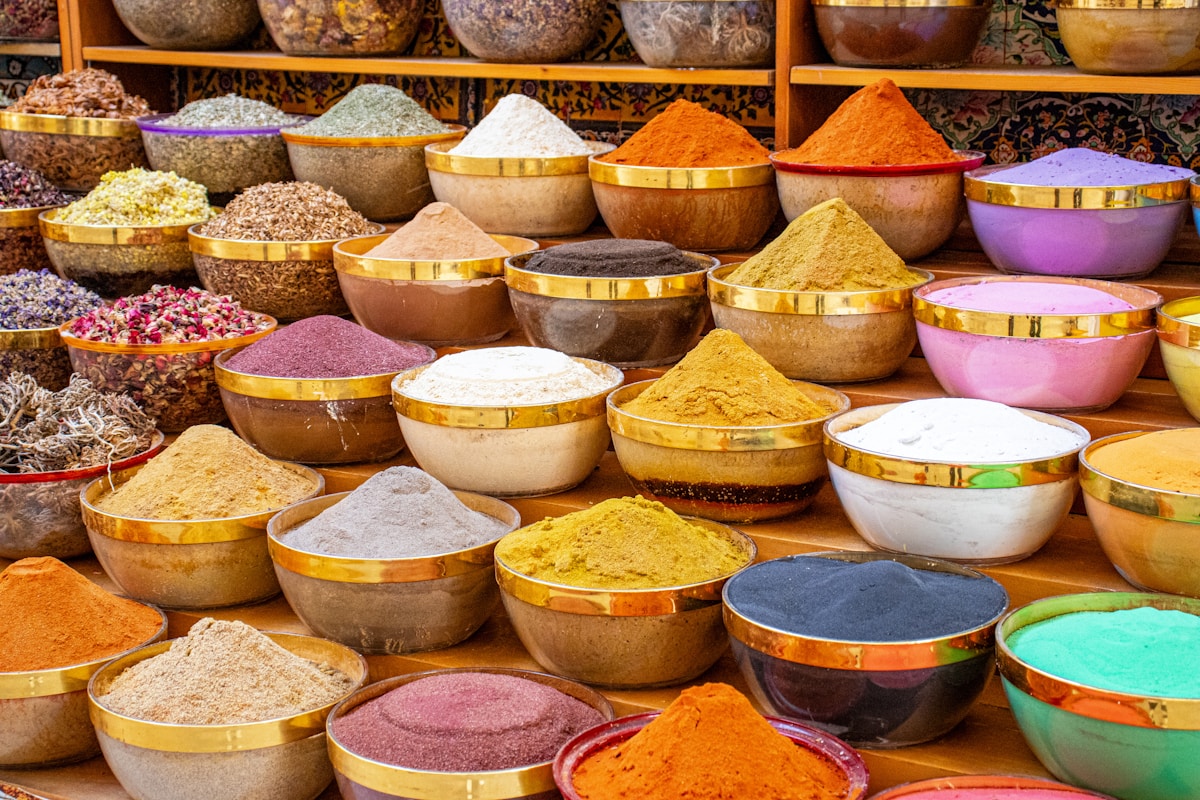
The Deira Spice Souk is a 15-minute walk or a two-minute abra ride across the Creek from Al Fahidi. The covered market sells dried spices in open sacks — turmeric, cumin, coriander, black lime (loomi), rose petals, frankincense, and saffron. The smell alone is worth the walk.
Food tours typically stop here to explain the spice trade that built Dubai and to try qahwa — traditional Arabic coffee brewed light with cardamom and occasionally saffron, served alongside dates. The coffee is intentionally mild, not the strong espresso of Italian tradition. Dates — the fresh, soft medjool variety or the firmer, caramel-sweet deglet nour — are eaten before or alongside the coffee, and the combination is one of the genuine pleasures of Emirati hospitality. Refusing a date is considered impolite; accepting and eating it is the expected gesture.
Shawarma Stands in Naif and Deira
No food walk through Dubai is complete without shawarma — thinly sliced rotisserie chicken or lamb in flatbread with garlic sauce, pickled vegetables, and hot sauce. Dubai’s best shawarma comes not from restaurants but from small streetside stands in Deira and Naif that have been feeding the city’s construction workers and taxi drivers for decades. A chicken shawarma costs approximately AED 8–15 depending on size and location.
The standard guide comparison is between chicken shawarma (lighter, with a yoghurt-garlic sauce) and meat shawarma (richer, often with tahini). Good shawarma has a slight char on the edges from contact with the rotisserie element and comes wrapped tight enough to eat standing up without collapse. Bad shawarma is limp. Your guide will take you to the good kind.
Meena Bazaar: Indian-Emirati Fusion
The area around Meena Bazaar, between Al Fahidi and Bur Dubai, reflects how thoroughly South Asian cuisine has become embedded in Dubai’s food identity over the past 60 years. Biryani at modest restaurants in this area costs approximately AED 20–30 for a full plate. Chaat stalls serve crisp fried snacks with tamarind and coriander sauces. The food is unmistakably Subcontinental but carries 60 years of local adaptation — spicier in some places, sweeter in others, adjusted to the tastes of communities that have lived here across two and three generations.
Key Dishes to Know Before You Go
Machboos (or Majboos): The closest thing the UAE has to a national dish. Long-grain rice cooked in a broth of meat (usually lamb or chicken), dried limes (loomi), turmeric, cinnamon, and coriander. The rice absorbs the broth as it cooks, picking up the tart, citrus-spiced flavour of the loomi. Found at Emirati-focused restaurants rather than street stalls. Approximately AED 35–55 per portion.
Luqaimat: Small, crisp-fried dough balls drizzled with date syrup and dusted with sesame seeds. Hot, slightly sweet, slightly salty — a common street snack, especially at Ramadan. Approximately AED 15–25 for a small bowl.
Harees: A slow-cooked porridge of wheat and lamb or chicken, stirred for hours until it reaches a smooth, sticky consistency. One of the oldest documented Emirati dishes and deeply associated with celebrations and the holy month of Ramadan. The texture puts some visitors off but the flavour — buttery, savoury, surprisingly light — is distinctive. Found at Emirati restaurants and hotel buffets during Ramadan and UAE National Day season.
Camel milk: Available at dedicated camel milk cafés in Dubai (Camelicious is the best-known brand) and increasingly stocked in supermarkets. The taste is saltier and thinner than cow’s milk with a slightly grassy note. Camel milk ice cream has become a tourist staple — richer than regular ice cream, with a faint savouriness. Approximately AED 20–35 for a scoop.
Balaleet: A sweet-savoury breakfast dish of vermicelli noodles seasoned with saffron, cardamom, and rosewater, topped with a thin egg omelette. The sweetness of the vermicelli against the savoury egg is an acquired taste but one that reflects the historic Emirati approach to the sweet-savoury boundary — more fluid than in most Western cuisines. Found at Emirati breakfast spots, usually in the morning only.
Self-Guided Food Walk: The Essentials
If guided tours aren’t your preference, a self-guided walk through the same area covers the major stops in approximately two to three hours:
- Start at Al Fahidi Heritage District — karak tea at any cafeteria on the main road, approximately AED 3–5
- Cross to Deira by abra (~AED 1) or walk via Al Maktoum Bridge
- Deira Spice Souk — browse and buy saffron or dried limes
- Gold Souk area — lunch at a Pakistani or Indian cafeteria for approximately AED 20–30
- Shawarma stop near Naif Market
- End at Dubai Creek waterfront — mint lemonade or fresh juice at a streetside stand
Practical Notes
Getting there: Union Metro station on the Green Line puts you in central Deira, walking distance from the Spice Souk and Gold Souk. Al Fahidi station on the Green Line is the nearest stop for the heritage district on the Bur Dubai side.
Best timing: Guided tours depart at approximately 09:30 for morning slots and 17:30 or 18:00 for evening slots. Evening is better from November through March; morning is better in April and October when temperatures are manageable but heat builds through the day.
Dietary requirements: Most operators accommodate vegetarian and halal requirements — all Dubai street food is halal. Inform your operator at booking if you have allergies to nuts, gluten, or dairy, as these appear in several traditional dishes.
Browse Dubai food tours, guided souk walks, and cultural experiences on GetYourGuide. For a broader UAE food primer before you travel, the UAE food guide covers the regional differences between Emirati, Lebanese, Iranian, and South Asian cuisines across the country. If you haven’t locked in your dates yet, the last-minute tours page shows food tour availability with same-day or next-day booking.
See Also
- Dubai Creek and Al Fahidi guide — the neighbourhood your food tour will cover on foot
- Dubai restaurants guide — sit-down dining across price ranges
- Best shawarma in Dubai — where to eat Dubai’s defining street food
- Dubai food and dining — full overview of eating in Dubai by neighbourhood
- 3-day Dubai itinerary — how to fit a food tour into a short trip
- Dhow cruise Dubai — a dinner cruise on the Creek pairs well with a daytime food walk
Frequently Asked Questions
- How much does a food tour in Dubai cost?
- Group food tours in Dubai start from approximately AED 350–420 per person (as of 2026) for a 3–4 hour guided walk covering Old Dubai and Deira. Private tours range from AED 650–1,000 per person. Prices typically include all food tastings but not transport to the meeting point.
- What food will I eat on a Dubai food tour?
- Expect shawarma, karak tea, luqaimat (honey-drizzled dumplings), samboosa, chebab (Emirati pancakes), machboos spiced rice, fresh hummus with pita, and Arabic coffee with dates. Many tours also include a camel milk tasting, which has a slightly salty, creamy flavour distinct from cow's milk.
- When is the best time to do a food tour in Dubai?
- Evening tours (starting around 18:00 or 19:00) are the most comfortable from October through April when temperatures drop. Morning tours (starting around 09:00–10:00) work in the cooler months. Avoid midday food walks from June through September — heat above 40°C makes outdoor walking genuinely unpleasant.
- Do I need to book a Dubai food tour in advance?
- Yes — small-group food tours typically cap at 10–12 people, and popular time slots fill within days, especially October to March. Book at least a week ahead during peak season (November–February). Cancellation policies vary by operator: most offer a full refund up to 24 hours before the tour.
Ready to explore?
Browse hundreds of tours and activities. Book securely with free cancellation on most options.
Browse on GetYourGuide →Best price guaranteed — same price as booking direct. We earn a small commission at no extra cost to you.