Food to Try in Abu Dhabi: What to Eat and Where (2026)
Book an experience
Things to do here
The top-rated tours and activities here — all with instant confirmation and free cancellation on most bookings.
Abu Dhabi’s food scene is less celebrated than Dubai’s but arguably more interesting for travellers who want to understand what Emiratis actually eat. The city is where Emirati cuisine is most accessible — more traditional restaurants, more community events, and less of the relentless tourist-menu homogenisation that can make Dubai’s food scene feel like an international airport terminal with good lighting.
Al Machboos — Start Here
Al machboos is the closest thing the UAE has to a national dish. Long-grain rice slow-cooked with chicken, lamb, or shrimp in a broth seasoned with loomi (dried lime), turmeric, cinnamon, cardamom, and rosewater. The dried lime is what separates it from biryani or pilaf — it gives the dish a distinctive sour-floral quality that grows on you quickly.
Where to eat it: Mezlai (Emirates Palace Mandarin Oriental) is the reference restaurant — mains from AED 80–140 as of 2026. The machboos with slow-cooked lamb is the dish to order. For a more modest setting, Bait Al Khetyar (Al Khalidiyah) runs a traditional Emirati family-restaurant format with machboos from approximately AED 45–60 per portion.
Harees — The Slow-Cooked Staple
Harees is a dish that confuses visitors because it looks unimpressive — a pale, thick porridge of wheat and shredded meat (usually chicken or lamb), finished with clarified butter and a dusting of cinnamon. Appearances mislead entirely. Slow-cooked for six to eight hours, the result is rich and deeply comforting. It is a Ramadan fixture and a staple at Emirati weddings.
Outside Ramadan, harees is available year-round at Mezlai (from AED 55 as of 2026). During Ramadan, the large hotels run community iftar spreads that include harees alongside full Arabic mezze — the Shangri-La Abu Dhabi and InterContinental Abu Dhabi both run highly rated Ramadan tents that are open to non-guests with reservations.
Fresh Seafood at Al Mina
Abu Dhabi’s fish market at Al Mina (the port district, about 5 km from central Abu Dhabi) is the best place in the emirate to eat fresh Gulf seafood. Arrive early — the market opens from around 05:00 and the best catch is selected by restaurant buyers before 08:00. Buy fresh hamour (grouper), kingfish, sea bream, or prawns directly from the stalls, and ask the vendors to clean and grill your purchase on-site. Hamour is typically AED 35–70 per kilogram as of 2026 depending on size; prawns AED 30–60 per kilogram.
For a sit-down seafood experience, Finz (Beach Rotana Hotel) overlooks the sea with a menu of Gulf and international catches — mains from AED 95–180 as of 2026. More informal but equally good is Al Dhafra Restaurant (near Al Mina) which serves the same fresh catch the market sells in a simple restaurant setting at AED 40–80 per portion.
Mezze — The Social Table
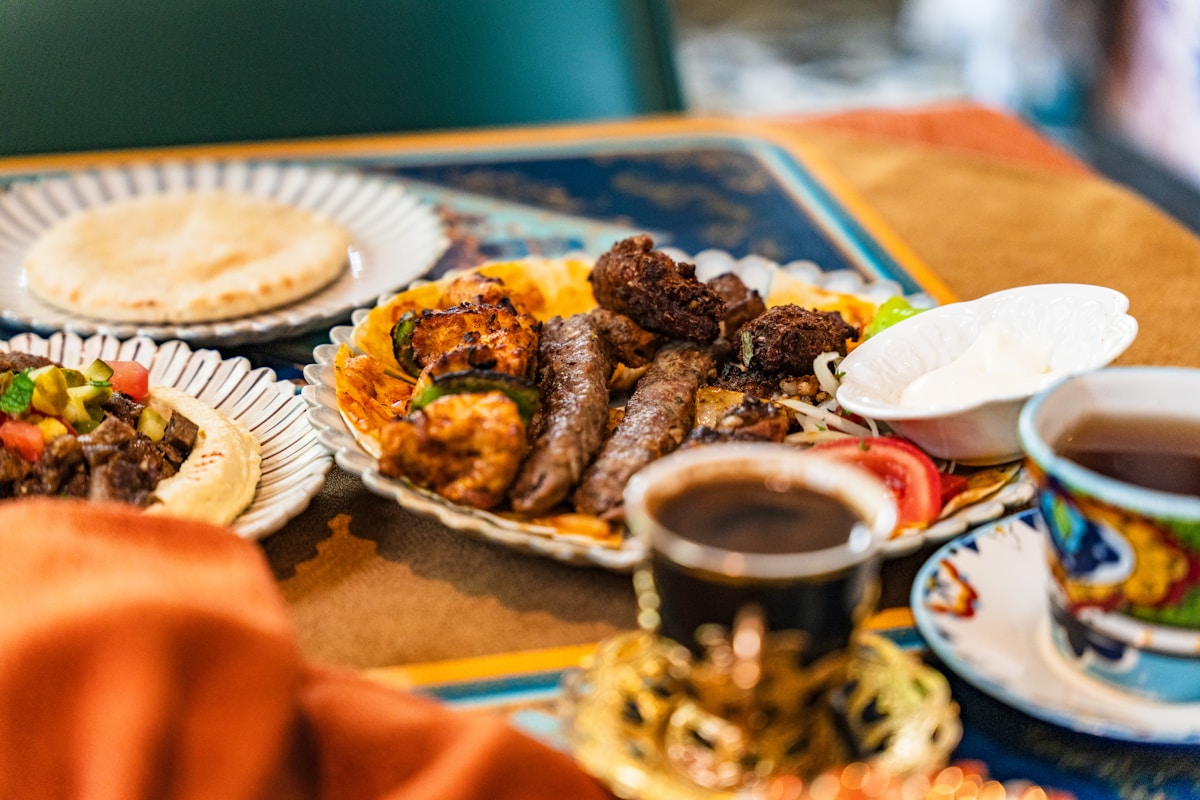
Mezze — the collection of small shared dishes from the Lebanese and wider Levantine tradition — is as fundamental to dining in Abu Dhabi as in Dubai. Hummus, mutabbal (smoky aubergine dip), tabbouleh, fattoush, kibbeh, and falafel form the base. A full table spread of six to eight dishes for four people costs approximately AED 150–280 at a mid-range Lebanese restaurant.
Where to eat it: Al Arish (Marina Mall area and Breakwater) is a well-established Abu Dhabi Lebanese restaurant with good mezze from AED 18–35 per dish. Lebanese Flower (Hamdan Street) is the budget option — the same quality as more expensive spots at roughly half the price, a full mezze and grill meal for two at AED 80–120.
Luqaimat and Traditional Sweets
Luqaimat — small deep-fried dough balls drizzled with date syrup and sesame seeds — are the most common Emirati street sweet. During Ramadan they are sold everywhere from AED 5–15 a portion. Outside Ramadan, the best places to find them in Abu Dhabi are the Souk Al Zafarana (the spice and traditional goods market near Al Mina) and the Abu Dhabi Heritage Village on the Breakwater, where vendors often prepare them on-site.
Traditional Emirati sweets also include om ali (a bread-and-nut pudding similar to bread and butter pudding with rosewater) and khabeesa (semolina with date syrup). Both are on the menu at Mezlai and Bait Al Khetyar.
Karak Chai — The City’s Fuel
Karak is tea brewed strong with evaporated milk, cardamom, and saffron. It costs AED 1–4 from any roadside kiosk or small café. Abu Dhabi’s South Asian communities drink it constantly; the habit has spread broadly. You will find karak carts near most government buildings, bus stations, and in Electra Street’s café cluster.
For a more considered version, Shakespeare and Co. (multiple Abu Dhabi locations including Khalidiyah and World Trade Centre) serves a well-spiced karak alongside a full café menu from AED 18–22.
Cheap Eating in Abu Dhabi
Abu Dhabi’s central streets — particularly around Electra Street, Hamdan Street, and the Al Mina district — have a dense cluster of Pakistani, Indian, and Bangladeshi restaurants serving full meals for AED 10–35. This is where the city’s large workforce eats daily and the quality-to-price ratio is excellent.
Sajway (multiple branches) is an Abu Dhabi institution for grilled Arabic-style chicken — a full chicken with rice and salad for approximately AED 25–35. Automatic Restaurant (Corniche area) is a Lebanese chain that has been operating for decades — reliable mezze and grills from AED 15–45 per dish.
Fine Dining in Abu Dhabi
The city’s fine dining scene is smaller than Dubai’s but has a handful of standouts:
- Hakkasan Abu Dhabi (Emirates Palace): Cantonese fine dining with Gulf views from the Emirates Palace complex. Dim sum from AED 60, mains from AED 120 as of 2026.
- Roberto’s (ADGM, Al Maryah Island): Italian with a regional following for its pasta programme. Three-course dinner from approximately AED 250 per person.
- Talea by Antonio Guida (Four Seasons Hotel Abu Dhabi, Al Maryah Island): Contemporary Italian in one of the city’s most refined settings. Tasting menu from approximately AED 450 per person.
For the full Abu Dhabi food scene — restaurant reviews by area, brunch options, and vegetarian dining — see our Abu Dhabi dining guide.
Frequently Asked Questions
- Where can I eat authentic Emirati food in Abu Dhabi?
- Mezlai (Emirates Palace Mandarin Oriental) is the most acclaimed Emirati restaurant in the city — mains from AED 80–140 as of 2026, with a full tasting menu from AED 295 per person. For a less formal option, Bait Al Khetyar (Al Khalidiyah) serves traditional Emirati home cooking at more accessible prices — AED 40–70 for mains.
- What is harees and where can I eat it in Abu Dhabi?
- Harees is a slow-cooked dish of wheat and meat (usually chicken or lamb) broken down to a thick porridge consistency and spiced simply with cinnamon and butter. It is a traditional Ramadan dish and is rarely on regular restaurant menus. Mezlai at Emirates Palace serves it year-round. During Ramadan, community iftar events at hotels like the Shangri-La Abu Dhabi and Traders Hotel include harees in their traditional spread.
- What is the cheapest good food in Abu Dhabi?
- The Al Mina and Electra Street areas in central Abu Dhabi have the best cheap eating — Pakistani and Indian restaurants serving full meals for AED 15–35 as of 2026. Shawarma from street kiosks costs AED 5–12. The fish market at Al Mina lets you buy fresh catch and have it grilled on-site for minimal cost.
Ready to explore?
Browse hundreds of tours and activities. Book securely with free cancellation on most options.
Browse on GetYourGuide →Best price guaranteed — same price as booking direct. We earn a small commission at no extra cost to you.